Grace Town and Dominic Sawyer’s car accident
Our Chemical HeartsGrace Town and Dominic Sawyer’s car accident is the fatal event at the center of Grace’s grief and Henry Isaac Page’s belated understanding of her. Dominic died at the scene; Grace survived with a badly injured leg, a long recovery, and a life organized around places and objects that kept the loss present. The novel withholds the essential fact that Dominic was driving until Grace tells Henry, turning earlier details of her behavior into evidence of a past he had not understood.
Background and Disclosure
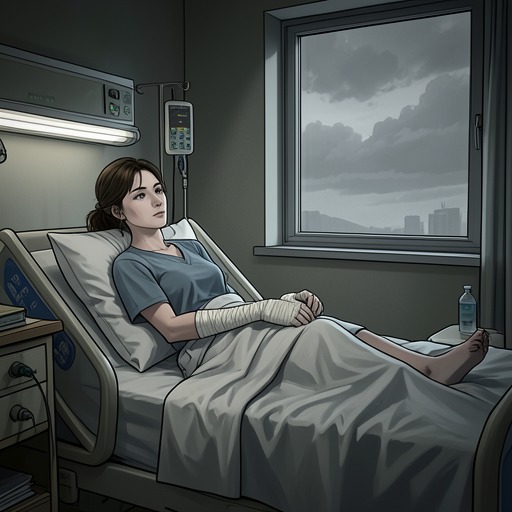
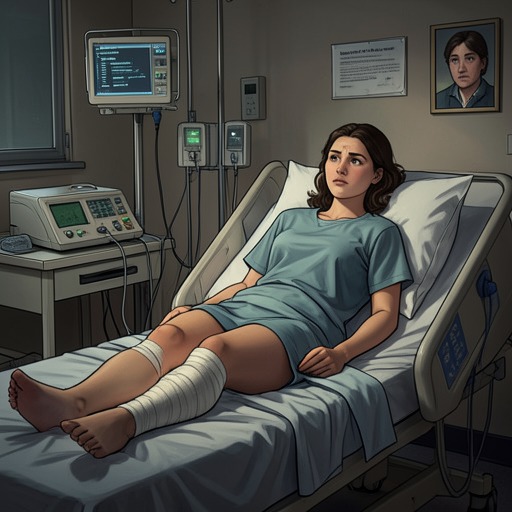
Grace first appears at school in oversized men’s clothing, unkempt and visibly unwell, walking with a cane. Her entrance is quiet: she arrives late, sits at the back of the black-walled drama room with the cane across her thighs, and says nothing. Henry initially notices her appearance but does not understand what the cane signifies. Later, when she describes the accident, she says it happened about three months earlier. The car flipped from hood to trunk seven times. She spent about a month in the hospital, received pins and skin grafts in her leg, and was mostly unconscious for a week. For another week, the pain was so severe that she wanted to die to escape it. Afterward, she had to learn to walk again and was left with extensive scars. She refuses to show Henry the scars at that point, making clear that disclosure does not mean surrendering control over her body or her privacy.
The first account gives Henry the physical outline of the crash but not its most consequential detail. That comes later, after he catches up with Grace near a bus stop. In the middle of her ragged, interrupted explanation, she tells him that Dominic was driving. She cannot finish saying what happened to him, but Henry understands that Dominic died. The information changes the meaning of the story in an instant: Grace was not simply a badly injured survivor mourning a boyfriend; she was the passenger who lived while the person at the wheel did not.
The Crash and Its Immediate Aftermath
Henry later searches online for an account of the crash. He struggles to find it because the report does not name Grace and he does not yet know Dominic’s full name. The article reports that classes at East River High School were suspended on a Wednesday after a junior died and another student was severely injured. It describes the passenger as an unnamed seventeen-year-old girl, believed to be the driver’s girlfriend, who remained in critical condition on Friday with major injuries. The car skidded off the road, flipped several times, and struck a tree. The report identifies the driver as seventeen-year-old Dominic Sawyer and says he died on impact; the passenger was rushed to hospital. A teacher remembers Dominic as kind and brilliant, while the school made counselors available to students and planned a memorial service.
The newspaper’s impersonal account supplies facts Grace’s broken explanation could not: the crash’s public consequences at school, Dominic’s death on impact, and the severity of Grace’s condition in the days afterward. Yet it leaves her unnamed, reducing her to a girlfriend and an injured passenger. Henry reads only fragments before closing the website. His discovery confirms what Grace has disclosed, but the report cannot explain what surviving has meant to her.
Lasting Injuries and Repetition
The accident’s consequences remain visible in Grace’s mobility. At East River High School’s track, Henry sees her attempt to run without her cane. She makes it roughly a hundred feet before stopping, screaming, and striking her injured leg again and again with the cane. The episode links her effort to test what her body can do with a punishing response to its limits. It also makes the injury more than a detail of her appearance: the leg has a history of treatment, pain, and repeated physical consequences that continue after the hospital stay.
When Grace later allows Henry to see her scars, he sees two large red rectangles on her upper thighs where skin was harvested for grafts. She explains that the first graft did not take and doctors had to return for more. The worst damage is on her calf, where skin and muscle were removed and the flesh covered with grafted skin; that leg is about half the size of the other. Fresh bruises and welts mark it after her attempt at the track. Pins have already been changed once, and Grace says doctors might remove them years later, though she does not know. Her account keeps the injury specific: scars, grafts, hardware, asymmetry, bruising, and uncertain treatment, rather than treating recovery as a simple return to her former condition.
Grief, Memory, and Consequences
The revelation also changes Henry’s understanding of Grace’s habits. The graveyard, oversized clothes, car, track, abandoned train station, and the music of The Strokes had seemed like disconnected mysteries. Once he knows Dominic was driving, these details read as traces of a life and relationship that preceded Henry. Grace tells him she transferred schools to get away from places she and Dominic had shared. She had not planned to like Henry or kiss him, and she did not want to be defined as the girl with the dead boyfriend. Her confession makes the accident the hidden context for their uncertain relationship, while exposing how little Henry had understood about the person he was falling for.
Dominic’s death is not resolved by the passage of time. Grace says that people watched her closely after he died, fearing she would kill herself, but insists she was not depressed: she was angry. Her grief includes a childhood bond that began when she was nine, when Dominic welcomed her into his family and treated her with patience. The eventual release of his keepsakes—including the anchor necklace she wore when Henry first saw her, a Strokes keychain, and Dominic’s unwashed Ramones shirt—takes place later at the abandoned train station. Grace lets the objects sink in the water, one by one. This is an act of relinquishment, not proof that the accident’s effects have disappeared.
Recovery and Narrative Significance
After Christmas, Grace’s limp becomes less noticeable and she stops using her cane. She begins driving to school and mostly wears her own clothes, though she sometimes still chooses something that belonged to Dominic. These changes mark physical improvement and a loosening of the self-punishing debt she has imagined herself owing; they do not erase the injury or the loss. Henry, too, begins to recover from the relationship’s end, eventually recognizing that he can survive even when Grace is no longer the first thought in his morning.
The accident is therefore both a physical catastrophe and the concealed history that governs what Henry initially misreads. Its facts arrive in stages: first the cane and scars, then Grace’s account of the hospital and pain, then the revelation that Dominic was driving, and finally the newspaper’s confirmation of his death and her critical condition. That delayed recognition makes the crash a turning point in Henry’s understanding, while the lasting bodily evidence prevents the revelation from being reduced to a single piece of backstory. Grace’s changing mobility accompanies her movement away from self-punishment, but the narrative presents recovery as gradual and unfinished rather than as a cure for grief.